
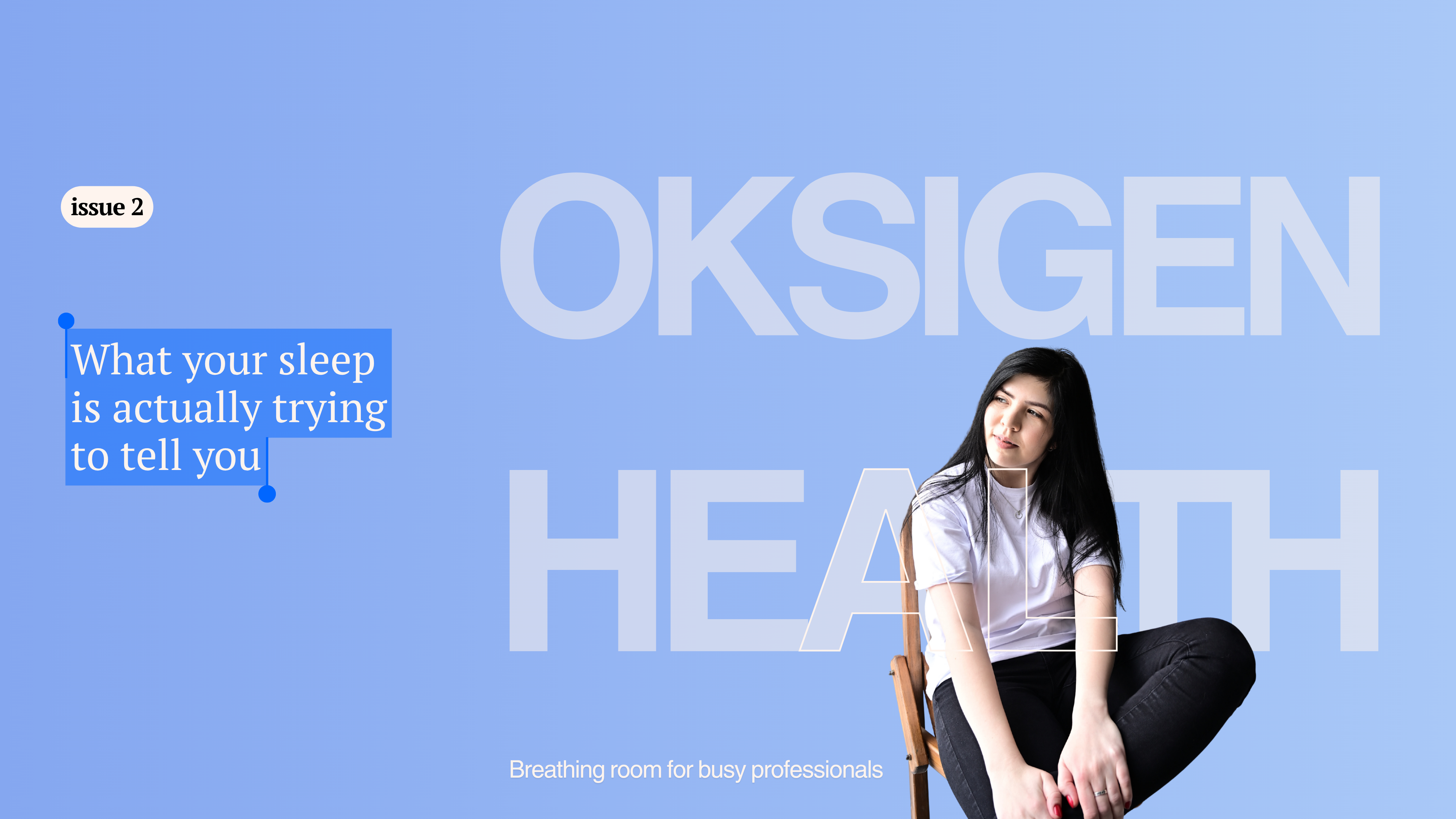
A few weeks ago, I led a group coaching session for my classmates called Rest to Rise, all about sleep as the foundation of well-being. The conversation stayed with me long after we logged off, so I wanted to bring some of it here too.
If your sleep had a weather report this week.
Before we get into the science, I want to ask you the same question I opened that session with. If your sleep had a weather report this week, what would it be? Foggy? Stormy? Calm? Sit with that for a second. There is no wrong answer, and there is no need to fix anything yet, just notice it. Awareness is always the first step, in sleep and in everything else.
Now think of a time you woke up feeling genuinely rested. What was different about that day? What did the rest of it feel like? Most of us already know what good sleep feels like, but we do not always know what got us there.
The science behind sleep.
Here is some of what we covered, in plain language.
Melatonin is often misunderstood. It is not a sleeping pill, rather, it is a darkness signal, your body’s way of announcing that night has arrived, and it depends heavily on light exposure to work the way it should.
Morning light matters just as much as evening darkness. Getting sunlight into your eyes within the first hour of waking helps reset your circadian rhythm, the internal clock that tells your body when to release melatonin later that night. Without that morning signal, the clock can drift, making it harder to fall asleep at a consistent time.
Your core body temperature actually needs to drop for you to fall and stay asleep. A room that is too warm can quietly work against you, no matter how tired you are.
When you eat matters too, not just what you eat. Finishing your last meal three to four hours before bed gives your body time to actually digest, instead of asking it to focus on digestion and recovery at the same time. Eating too close to bedtime can also work against that drop in core body temperature your body needs to fall asleep.
While you sleep, your brain is not simply resting, it is cleaning itself, through something called the glymphatic system, which clears out waste that builds up during the day.
Your chronotype matters too. If you are not a natural early riser, that is not laziness. You may simply be wired differently, and working with that instead of against it changes everything.
Sleep and appetite are more connected than most people realize. When you are sleep deprived, two hormones shift in a way that works against you. Ghrelin, often called the hunger hormone, rises. It is produced mainly in your stomach, and its job is to signal your brain that it is time to eat. At the same time, leptin, the hormone that tells your brain you are satisfied, drops. So, on a poorly slept day, you are not just imagining that you feel hungrier. Your body is chemically primed to want more food, and those cravings tend to lean toward high-calorie, high-carbohydrate foods rather than a salad.
And then there is screen time. Blue light in the evening does not just make it harder to feel sleepy. It interferes with the specific mechanism your body uses to know it is time to wind down.
As sleep researcher Matthew Walker puts it, “Sleep is the single most effective thing we can do to reset our brain and body health each day.“
Your experiment. Your data. Your call.
I do not want this newsletter to just be ideas without action, so here is one small thing to try before the next issue. Pick one variable, just one, and treat it like an experiment rather than a rule. Maybe it is your room temperature. Maybe it is putting your phone down thirty minutes earlier than usual. Or maybe it is simply noticing what you already tried before, and what actually helped.
Whatever you choose, the point is not to get it perfect, but to gather your own data, and to let that data guide your next small adjustment.
Resource corner: Why We Sleep, by Matthew Walker.
If you want to go deeper into everything we touched on this issue: melatonin, the glymphatic system, chronotypes, and yes, ghrelin and leptin too, this is the book I keep coming back to. Matthew Walker is a neuroscientist and sleep researcher, and he makes the science behind sleep easy to understand. It is the book that first made me realize how much I had been underestimating sleep as a health tool, not just a nice-to-have.

Before you go.
So, what is your sleep’s weather report this week? And what have you already tried? I would genuinely love to hear it in the comments.
More soon, Oksi
Disclaimer: I am not a doctor, and nothing in this newsletter is medical advice or a diagnosis. This content is shared for educational purposes only, based on my own experience and ongoing training in functional medicine health coaching. Please consult your own healthcare provider before making changes to your care.